What is estimated 1RM?
Estimated 1RM (e1RM) is a projection of the heaviest single you could have lifted, from a set you already did with more than one rep. Setlane calculates it on working sets you log. It is not a tested max and not a training prescription. Use it to compare similar work over time, not to replace a heavy single.
The reason to keep it is comparison. 80 kg × 8 and 85 kg × 5 are awkward to judge by eye. The estimate puts them on one line so you can see whether performance changed across the block when the top weight stayed put.
| Logged set | Calculation | e1RM |
|---|---|---|
| 80 kg × 8 | 80 × (1 + 8 / 30) | 101.3 kg |
| 85 kg × 5 | 85 × (1 + 5 / 30) | 99.2 kg |
| 92.5 kg × 8 | 92.5 × (1 + 8 / 30) | 117.2 kg |
85 kg is the heavier load, but 80 kg for 8 gives the higher estimate: 101.3 versus 99.2 kg. That does not prove which set required more effort or what you could lift for one rep.
How is e1RM calculated?
Setlane estimates 1RM with Epley’s formula: e1RM = weight × (1 + reps / 30). According to Boyd Epley (1985), that is a linear projection from a submaximal set. Wikipedia’s one-repetition maximum article documents the same equation and notes Epley and Brzycki are the most commonly used formulas. Setlane applies it to the weight you logged, in kilograms or pounds, with no repetition cap in this version.
e1RM = weight × (1 + reps / 30)
Take 92.5 kg for 8 reps, as it would appear after a logged set:
92.5 × (1 + 8 / 30) = 92.5 × 1.266… = 117.2 kg after rounding to one decimal. That is the public record value in the app. Comparisons inside Setlane use the raw number before rounding, so two sets that round to the same tenth can still be ordered correctly.
There is no repetition cap in this version. A 20-rep set still produces an estimate. That is a limitation, not a feature: the formula was published for strength work, not pump sets. The Epley 1RM calculator uses the same equation if you want to try a set before you log it.
- Epley, Boyd. 1985. “Poundage Chart.” Boyd Epley Workout. Lincoln, NE: Body Enterprises. Bibliographic source for the formula, as cited on Wikipedia, “One-repetition maximum”.
- LeSuer, D. A., McCormick, J. H., Mayhew, J. L., Wasserstein, R. L., & Arnold, M. D. (1997). The accuracy of prediction equations for estimating 1-RM performance in the bench press, squat, and deadlift. Journal of Strength and Conditioning Research, 11(4), 211–213. https://doi.org/10.1519/00124278-199711000-00001
How accurate is estimated 1RM?
An estimated 1RM is a poor stand-in for a tested max when reps are high, when the set was not close to failure, or when the load is stored as 0 kg. According to LeSuer et al. (1997) in the Journal of Strength and Conditioning Research, predicted and tested 1RMs were highly correlated (r > 0.95), but several equations still differed from the tested lift, and all seven underestimated deadlift.
- Repetition range. Prediction error depends on the lift, population and protocol. Reynolds, Gordon and Robergs (2006) found their 5RM data predicted bench and leg-press 1RM more accurately than 10RM or 20RM data. This is not a universal eight-rep cutoff for Epley.
- How hard the set was. The formula does not know RPE, RIR, rest, or range of motion. Two sets of 80 × 5 can be very different work.
- Zero load. A set stored at 0 kg produces 0 e1RM. Unloaded pull-ups and similar work will not create a Best e1RM.
- It is not a program. Setlane will not convert the estimate into next week’s percentages. If you want that, do it yourself or ask ChatGPT after you have a log, then review anything before it writes a template.
Where is e1RM in Setlane?
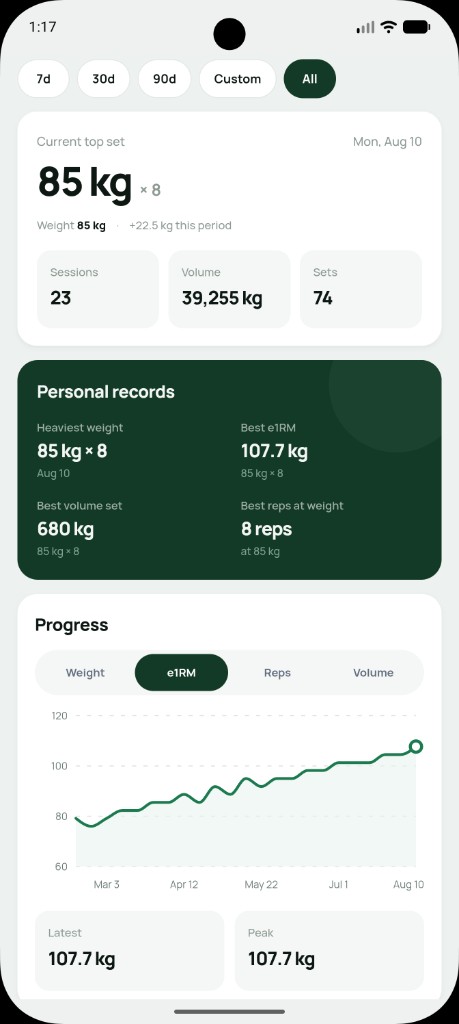
On Setlane Pro, each exercise can chart e1RM over a period you pick. Best e1RM is also one of the four personal record cards, and a workout can earn Best e1RM when that session’s raw value beats history. Setlane Free still logs the sets; it does not show the e1RM chart or the Best e1RM card. ChatGPT and Claude follow the same plan limits.
You can log in kilograms or pounds. The Epley 1RM calculator uses the same formula with a kg / lb toggle.
How to read an e1RM trend
| Session | Top set | e1RM |
|---|---|---|
| 1 | 80 kg × 8 | 101.3 kg |
| 2 | 80 kg × 9 | 104.0 kg |
| 3 | 82.5 kg × 8 | 104.5 kg |
| 4 | 82.5 kg × 8 | 104.5 kg |
The first increase comes from an extra rep. The next comes from a heavier load at fewer reps. The last is unchanged. Small differences in an estimate can reflect ordinary variation; look at the underlying sets and several sessions before concluding that strength has changed.
Use the progressive-overload guide to put this alongside weight and reps, and volume load and set count to understand how much work accompanied it.
What happens at one rep? Setlane applies the same formula without a special case: 100 × (1 + 1 / 30) = 103.3. If you actually tested 100 kg for one rep, the tested result is 100 kg. The formula output does not replace that fact.
Frequently asked questions
Which 1RM formula does Setlane use?
According to Boyd Epley (1985), e1RM = weight × (1 + reps / 30). Setlane uses that formula on the weight you logged, in kilograms or pounds. Public record values are rounded to one decimal place. There is no repetition cap in the current version. Sources are linked in the formula section above.
Is estimated 1RM the same as a tested one-rep max?
No. It is a projection from a submaximal set. According to LeSuer et al. (1997) in the Journal of Strength and Conditioning Research, predicted and tested 1RMs were highly correlated but several equations still differed from the tested lift. Use it to compare similar work over time, not as a substitute for a heavy single.
Why is my bodyweight e1RM zero?
Setlane stores weights in kilograms. A set logged at 0 kg produces an estimated 1RM of 0. Unloaded work does not create a Best e1RM.