What is a drop set?
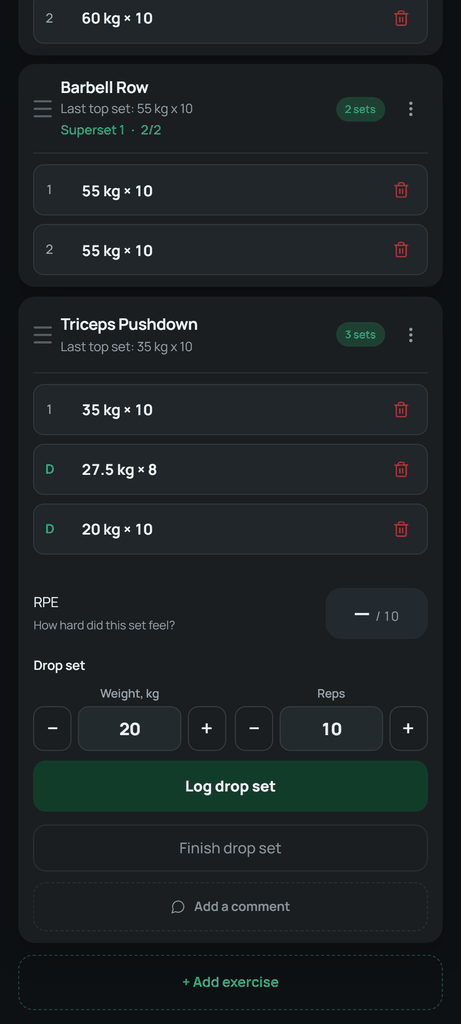
A drop set stays within one exercise: after a demanding set, reduce the weight and continue with little or no rest. Each lighter stage has its own weight and repetitions. For example, a cable triceps pushdown of 35 kg × 10, followed by 27.5 kg × 8 and 20 kg × 10. Keep the main set and both drops together instead of writing a single total of 28 reps.
Choose an exercise with quick weight changes
A cable pushdown, machine curl or leg extension makes the sequence easy to organize because changing a pin is quick. Dumbbells can also work if the next pair is ready. If changing the load takes a long time, the pause changes the comparison. A demanding free-weight setup is harder to manage as fatigue rises.
How to perform and record the sequence
Start with the working set from your routine, reduce the load, and continue at the lighter weight. Choose the reductions and a stopping target you can repeat; there is no single required percentage or number of drops. Stop when you reach your planned reps or effort limit while maintaining your intended technique. Complete failure at every stage is not what defines a drop set.
A 2023 systematic review found no clear muscle-growth advantage over traditional sets, while drop sets could require less time. Extra fatigue is not proof of extra progress. [1]
How to record a drop set in Setlane
- Log the main set normally. Open that exercise’s three-dot menu and turn on Drop set before recording the lighter continuation.
- Enter the reduced weight and completed repetitions, then tap Log drop set. Repeat for each further reduction; do not combine the weights or repetitions into one entry.
- Tap Finish drop set when the chain is complete. Rest then follows the exercise’s settings, or the superset’s round if that exercise belongs to one.
Rest between drops and after the chain
Within the chain, the short transition is for changing the weight rather than taking a normal recovery break. After the final stage, allow recovery before the next planned set. If you add a long pause or another drop next time, treat that as a changed structure when comparing performance.
Save the structure in a routine
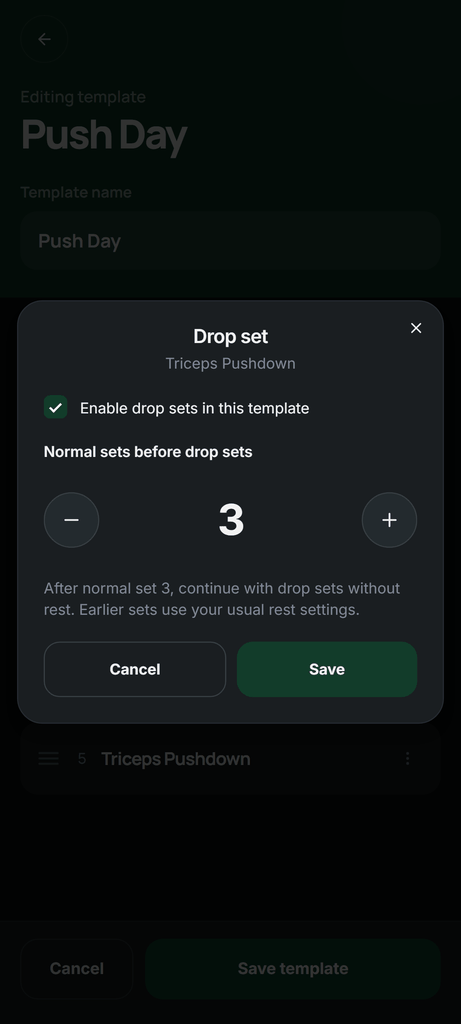
You can prepare a drop-set rule in Templates. Edit a routine, open an exercise’s menu and choose Drop set. Set how many normal sets come before the drops. The rule describes the structure; you still record the weights and reps you actually complete.
The screenshot sets three normal sets before the drop phase. The earlier normal sets use the usual rest settings; after the third normal set, continue with the lighter stages without an intervening rest. Supersets and drop sets are available on Free.
How to compare progress fairly
For drop sets, compare the main set first, then each drop at the same position in the chain. More reps on a lighter final stage do not, by themselves, show that your main-set strength improved.
Weight, reps and effort answer different questions. Record RPE when useful, and review comparable sessions in History. For muscle-group progress, Setlane treats drop sets as activity rather than estimated-strength results. A bigger session total can reflect extra work, not necessarily a stronger lift.
You do not need to turn every final set into a drop set to keep progressing.
A worked example: more work or a stronger main set?
| Session | Main set | First drop | Second drop |
|---|---|---|---|
| 1 | 35 kg × 10 | 27.5 kg × 8 | 20 kg × 10 |
| 2 | 35 kg × 10 | 27.5 kg × 8 | 20 kg × 12 |
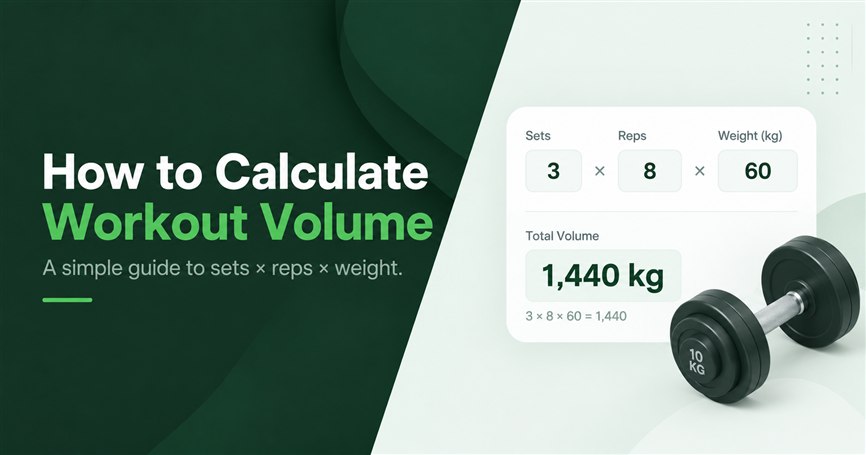
In session 2, only the final drop changes: 12 instead of 10 reps at 20 kg. Volume rises from 770 to 810 kg, an extra 40 kg of volume load. That is more recorded work in the final stage; the main set is still 35 kg × 10. Treat it as a useful improvement in that stage, not proof of a higher one-rep max.
Common logging mistakes
Do not record all 28 repetitions at the starting weight, or average the three weights into one entry. Both approaches lose the real sequence. Keep each stage’s weight and reps, close the chain when it is finished, and distinguish a warm-up set from a lighter continuation after a hard working set.
Frequently asked questions
How much weight should I reduce in a drop set?
There is no universal reduction. Choose an available lighter load that lets you continue with the intended technique and rep or effort target. Record the actual load at every stage so you can repeat and compare the sequence.
Is one drop-set chain the same as three normal sets?
Not automatically. The stages have different loads and much shorter recovery. You can calculate their volume load, but there is no universal conversion that makes the chain equivalent to a fixed number of normal working sets.
Should I add all drop-set reps into one set?
No. Record each weight and its completed reps separately, and keep the entries in the same drop-set chain. A single rep total loses the information needed to compare the stages.
Are drop sets included in Setlane Free?
Yes. Logging drop sets and saving their structure in routines are included in Free.